Filming and editing short videos for TikTok and other platforms
Visual design concepts and the role of artificial intelligence
Every high-quality article on digital content creation requires visual material that accurately reflects the essence of the topic — a balance between accessible mobile filming and professional post-production.
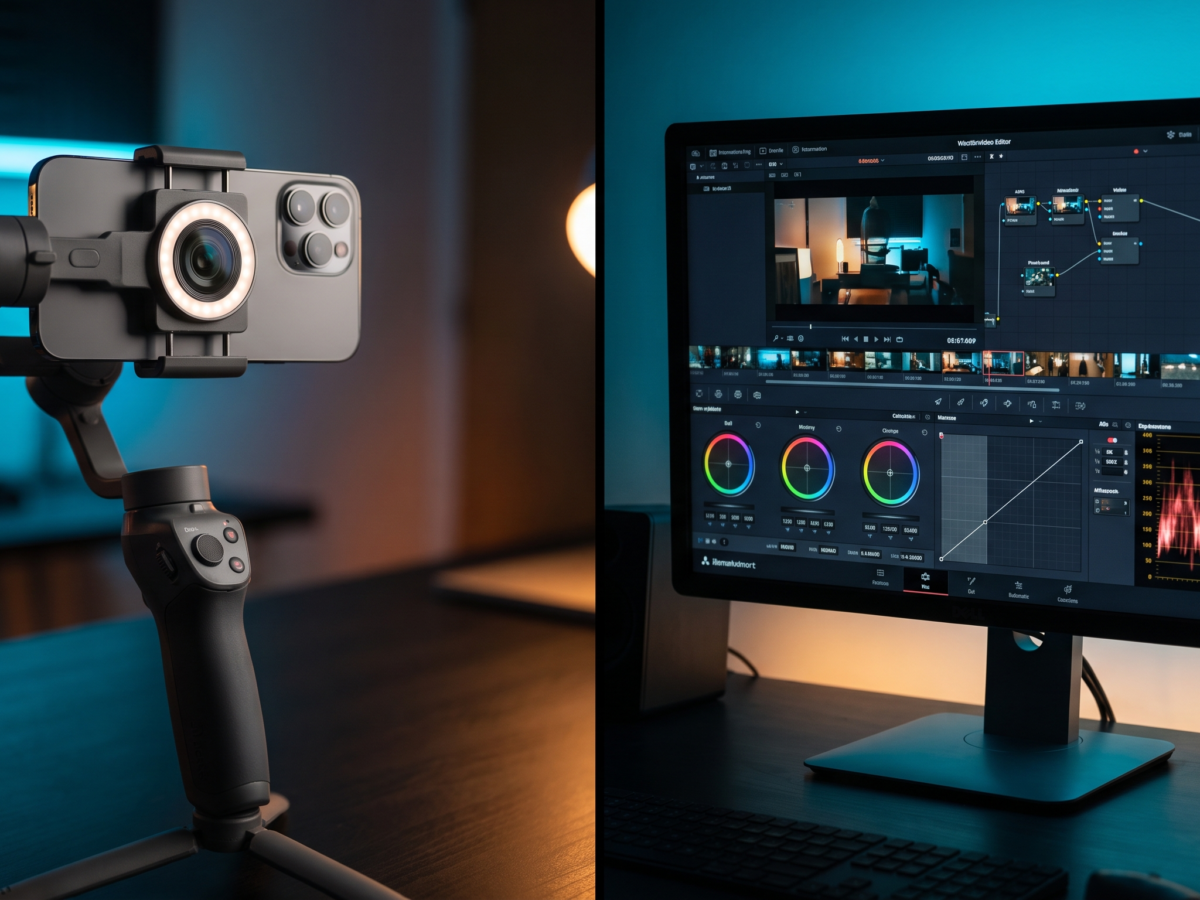
The image description shows the merging of two worlds into a single cinematic frame. On the left is a modern smartphone mounted on a three-axis motorised stabiliser and fitted with a compact ring light on the camera lens. On the right-hand side is the monitor of a professional video editing workstation, displaying a highlighted timeline, audio waveforms and colour correction panels. The background is rendered in dark, cinematic tones with subtle neon blue and warm amber lighting.
Artificial intelligence prompt for image generation: Cinematic split-perspective shot of modern short-form video creation. On the left-hand side, a high-end smartphone mounted on a professional motorised gimbal with a soft ring light reflection in the camera lens. On the right, a video editor’s workstation monitor displaying dynamic timeline video tracks, colour grading wheels and complex audio waveforms. A dark studio background with subtle neon blue and warm amber lighting; hyper-realistic, 8K resolution, photorealistic style, sharp focus, 16:9 aspect ratio.
The mobile filming paradox: accessibility versus the trap of amateurism
The transformation of social media platforms has made short-form videos, such as TikTok, Instagram Reels and YouTube Shorts, the primary tool for organic reach and audience engagement across Europe and in Latvia. In Latvia alone, the TikTok platform is actively used by around 900,000 users, providing a unique environment in which even a small business or an individual content creator can organically reach a wide audience without a huge advertising budget.
Modern smartphones are equipped with superb camera sensors capable of recording footage in 4K and even 6K resolution. This technological accessibility creates the deceptive illusion that, to create successful content, all one needs to do is switch on the camera and film without much thought. In practice, however, there is a rapidly widening gap between authentic, visually appealing content and amateurish video clutter.
The main paradox of mobile filming lies in the fact that a mobile phone provides technical access but does not ensure visual direction and aesthetics. More often than not, a video shot on a mobile phone by the user themselves suffers from hidden flaws that the viewer subconsciously picks up on within a fraction of a second. Inadequate or uncontrolled lighting creates visual noise, whilst room reverberation and muffled sound cause the viewer to skip the video immediately, whilst a lack of post-production makes the image dull and lacklustre. If the content looks too amateurish, algorithms will not promote it to a wider audience, whilst consumers perceive it as a sign of low quality, which damages the brand’s credibility. Therefore, successful mobile filming is inconceivable without deliberate post-production and editing techniques that transform raw footage into a targeted product.
Methods, techniques and shot density in the vertical format
In the short-form video format, the key metric is the viewer’s attention. User behaviour patterns indicate a low patience threshold, which means that the visual structuring of content must be extremely precise and dynamic.
Analysis shows that the first three seconds in particular determine whether a user will continue watching the content or skip it. The beginning of the content must be visually or aurally intense. Instead of starting with a slow introduction or a greeting, the frame must immediately show the climax of the action, an intriguing question or a visual break that grabs the viewer’s attention.
One of the most common signs of amateurism is a static shot lasting longer than three seconds. TikTok and Reels videos demand high visual density. By using jump cuts, all pauses and breaths are edited out of the talking-head format, creating a continuous flow of speech. Similarly, even during a single interview, the frame scale is changed every few seconds using digital zoom in the edit, whilst the main voice recording is supplemented by illustrative B-roll footage, details of the process or close-ups of objects, which maintain the visual dynamism.
Filming in the vertical 9:16 aspect ratio requires specific compositional rules. Although the rule of thirds remains relevant, the main focal point must be located in the top third of the screen, where the viewer’s natural line of sight falls. It is extremely important to ensure safe zones at the bottom and on the right-hand side of the screen so that platform interface elements, such as descriptions, buttons and usernames, do not obscure important visual details or subtitles.
The importance of post-production and editing effects: where professionalism is born
Whilst filming with a smartphone provides the raw footage, post-production is the stage at which this material acquires commercial and professional value. Relying solely on the camera’s raw footage indicates an incomplete production cycle.
Smartphone cameras often use aggressive built-in algorithms that oversaturate colours or make shadows unnaturally black. The post-production process involves tonal correction and colour balancing, giving the image a consistent and aesthetic style. By using professional colour profiles and correction, a smartphone shot can be made to resemble a cinematic look.
Audio clarity and sound design account for at least half of the video’s perceived quality. Post-production involves suppressing background noise, removing room reverberation and adjusting voice frequencies, making speech clear and pleasant. This process is complemented by multi-layered sound effects, such as sounds for movement and text appearance, synchronised with visual transitions, as well as licensed background music with an adjusted volume level.
As a large proportion of social media users watch short videos with the sound turned off, dynamic captions centred on the screen have become an essential standard. Captions must be easy to read, using high-contrast fonts, highlighted text and animated transitions that keep the viewer’s attention centred on the screen.
Five critical mistakes in the self-filming process
Unnecessary use of automatic exposure and focus
As the camera constantly tries to adjust to changes in lighting or movement within the frame, the image begins to flicker and vary in brightness. This creates an amateurish impression, which can be avoided by manually locking the focus and exposure before filming.
Recording from a distance with the built-in microphone
When filming from a distance of more than one metre from the phone, the built-in microphone does not capture clear speech, but rather room reverberation and ambient noise. Failing to use an external wireless microphone is one of the most common mistakes that reduces the watchability of a video.
Ignoring the cleanliness of the camera lens
Fingerprints and a layer of grease on the smartphone’s camera lens result in a blurry image and bright streaks around light sources. Wiping the lens with a microfibre cloth is a basic but often overlooked step before every recording.
Failing to observe the safe zone on the screen
Placing text, logos or faces at the edges of the screen often results in them being obscured by elements of the app’s interface, such as buttons or video description text. This makes the content difficult to view and indicates careless framing.
Static and slow-paced plot development
Starting a video with long introductory phrases and slow plot development is guaranteed to lose viewers within the first few seconds. The essence of the content and the visual hook must be shown immediately, without wasting time on unnecessary formalities.
Practical tips and tricks for a professional look
What sets a standard recording apart from high-quality content is a mastery of technical details during filming. It is recommended to film talking-head segments and standard scenes at 24 or 30 frames per second (FPS), which ensures natural motion blur and a pleasant viewing experience. Dynamic B-roll shots and action sequences, on the other hand, are best recorded at 60 or 120 FPS so that smooth slow-motion effects can be created in post-production.
Lighting doesn’t have to be complicated, but it must be controlled. It’s best to use at least one soft light source, positioned slightly above eye level at a 45-degree angle to the face. Although natural light from a window is a good alternative, it is variable and can cause tonal differences between different takes.
Instead of the built-in camera app, it is advisable to use specialised mobile camera apps, such as Blackmagic Camera, which allow you to manually set the shutter speed, ISO and white balance, preventing digital overexposure and colour shifts. For shots taken whilst moving, it is advisable to use a motorised three-axis stabiliser or a specific walking technique with bent knees, which prevents sharp camera vibrations.
A comparison of DIY and professional production approaches
| Parameter | Simple self-filming with a mobile phone | Hybrid and professional post-production |
|---|---|---|
| Visual quality and colour depth | Automatic camera algorithms, flat colours, digital noise in the shadows |
Professional colour correction, contrast and tone balancing |
| Audio processing and SFX | Built-in microphone, room reverberation, fluctuating volume levels |
Noise reduction, EQ voice smoothing, multi-layered sound effects |
| Frame dynamics and rhythm | Static shots, monotonous camera angles, pauses and stammering between sentences |
Dynamic shot changes, speed manipulation, micro-cuts |
| The first 3 seconds and consistency | Slow introduction, delayed reveal of the main message |
Well-thought-out visual and auditory hooks, dynamic captions |
| Perception of credibility and brand value |
Amateurish impression, lower viewer retention |
High visual authority, a professional image and longer viewing time |
Questions and answers
Is a smartphone a sufficient tool for creating commercially successful TikTok and Reels videos?
Modern smartphones offer sufficient technical resolution to record high-quality source footage. However, a phone alone is not enough to achieve commercial-grade results. Ultimate success depends on the right choice of lighting, the use of an external microphone, dynamic framing and in-depth post-production, such as captions, colour correction and sound design.
What is the ideal length for short videos to ensure high viewer retention?
Although platforms allow videos lasting several minutes to be published, clips lasting between 15 and 30 seconds achieve the highest retention rates. This length allows for maximum visual intensity and a dense flow of information, preventing the viewer from becoming bored.
Why do self-filmed videos often fail to achieve the desired viewership figures?
The most common reasons lie in the lack of a visual hook in the first three seconds, poor-quality sound with room echo, static and ill-considered framing, as well as a lack of post-production. If a video lacks dynamism and captions, algorithms detect that users are quickly abandoning the content.
What role does the integration of professional elements, such as drone footage, play in the development of short videos?
Supplementing mobile phone footage with cinematic drone shots or in-depth B-roll material significantly increases the perceived value of the content. This hybrid approach makes the video more memorable and lends the brand additional authority in the saturated social media landscape.
In conclusion
Filming short videos with a smartphone is the most effective way to ensure a regular and authentic flow of content on social media platforms. A smartphone removes technological barriers and allows you to respond quickly to industry trends and audience needs.
The main challenge lies in the belief that a simple phone recording is sufficient for long-term success. To stand out amidst growing content saturation, content creators and businesses must move from spontaneous self-filming to a structured production process. This process requires thoughtful framing and visual intensity through dynamic shot composition, the use of external lighting and audio equipment for clear sound, as well as professional post-production — colour grading, editing rhythm, dynamic title design and sound design. By combining the flexibility of mobile cameras with rigorous post-production standards, it is possible to create short videos that not only grab attention within the first few seconds, but also build long-term brand loyalty and deliver measurable business results.